

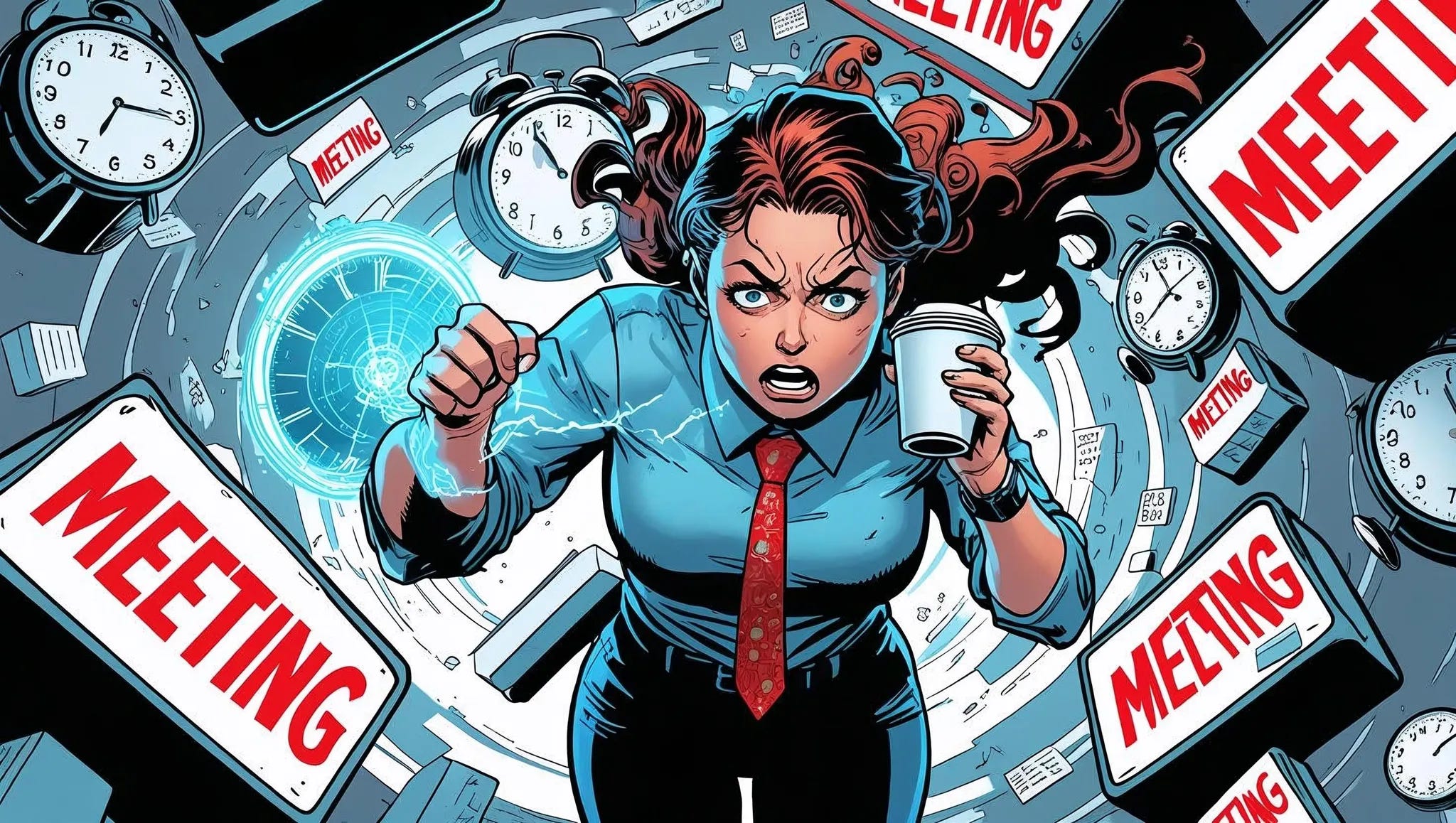
The Signal in Your Calendar
Pull up your calendar from last month. Not this week. Not today. Last month. The one that’s already finished. The one you can’t change anymore.
Now count the hours. All of them.
How many meetings? How many blocks of time you actually controlled? How many hours disappeared into email and Slack? How many times did you context-switch between vastly different types of work?
Do the math. Be honest about what you find.
I’ll wait.
The average knowledge worker spends 11.3 hours per week in meetings but considers only 25% of them productive. If you’re in leadership, the numbers get worse: 23 hours per week in meetings. That’s more than half your workweek spent in rooms talking about work instead of doing it.
But statistics are abstract. Your calendar isn’t. It’s a ledger. It shows exactly where your capacity went, not where you thought it went. And the gap between those two things? That’s where the execution problem lives.
What the Math Actually Shows
Let’s be specific about what a realistic week contains.
Start with 40 hours. That’s the theory anyway.
Subtract meetings. If you’re typical, that’s 11-15 hours for individual contributors. If you’re in leadership, 20-25 hours. Let’s be conservative and say 15 hours.
You’re at 25 hours remaining.
Subtract email and communication tools. Studies show knowledge workers spend 28% of their workweek on email alone. That’s another 11 hours. But let’s be generous and assume you’re efficient. Call it 6 hours for email and Slack combined.
You’re at 19 hours remaining.
Now subtract the invisible tax: context switching. Every time you shift from one type of work to another, you pay a cognitive cost. Research shows it takes an average of 23 minutes to fully regain focus after an interruption. Your calendar shows those interruptions as empty space between meetings. They’re not empty. They’re recovery time.
How much context-switching happened in your week? Between meetings, between domains, between strategic thinking and operational execution? Even if you’re disciplined, that’s easily 4-6 hours of cognitive overhead that shows up nowhere on your calendar but costs you everywhere in your work.
You’re at maybe 13-15 hours of actual execution time.
But wait. Look at your task list. Look at your project commitments. Look at what you told people you’d deliver. How many hours of focused work does that actually require?
If you’re like most high-performers, the answer is 25-35 hours minimum.
The math doesn’t work. It never did. Your calendar has been screaming this at you for months. You just haven’t had permission to see it.
The Pattern You’ve Been Missing
Here’s what your calendar reveals when you actually look at it:
Strategic work happens at the margins. The big projects, the important thinking, the work that actually moves things forward? It’s squeezed into early mornings before meetings start. Late evenings after the day ends. Weekends when the communication channels finally go quiet.
Your calendar blocks say “focus time” or “project work.” But look at what actually happened during those blocks. Half of them got interrupted by “quick questions” that weren’t quick. Emergency calls that weren’t quite emergencies. “Just checking in” messages that required 20 minutes to handle properly.
The blocks existed. The focus didn’t.
Meanwhile, reactive work dominates your prime hours. Not because you chose it. But because reactive work comes with built-in urgency, and other people are attached to it. Someone scheduled that meeting. Someone sent that urgent request. Someone escalated that issue. Each one is individually justifiable. The collective load unbearable.
Your calendar shows you responding to everyone else’s priorities while your own work happens in the gaps. If it happens at all.
This is what calendar pollution looks like. Not a schedule problem. An allocation problem. Your time went exactly where the system directed it. The system just directed it away from the work that matters most.
The Double Cost Nobody Counts
Every meeting on your calendar costs you twice.
Once for the meeting itself. That’s the visible cost. The hour blocked on your calendar. The time in the room or on Zoom.
But there’s a second cost that never shows up in the calendar: the context-switching overhead.
You were deep in strategic planning for Project A. Had momentum, had clarity, had the mental model fully loaded. Then you had a 30-minute status update meeting about Project B. Completely different domain. Different stakeholders. Different context. Different problems.
The meeting took 30 minutes. But returning to Project A afterward? That’s not instantaneous. You have to reload the mental model. Remember where you were. Reconstruct your thinking. Research shows this takes an average of 23 minutes.
So that 30-minute meeting actually cost you 53 minutes. And that’s assuming you had time to return to Project A at all. If you had another meeting after that one, you never got back to deep work. The whole afternoon fragmented into shallow context-switching.
Your calendar shows the meetings. It doesn’t show the switching cost. But that switching cost is why you end the day exhausted despite never actually completing anything substantial. You spent 8 hours working but only 2 hours producing.
The productivity illusion: you were busy all day. The productivity reality: you were present but not progressing.
Why This Pattern Persists
You’re smart. You know the calendar is a problem. So why haven’t you fixed it?
Because fixing it feels dangerous.
Declining a meeting means potentially missing something important. Saying no to a stakeholder means risking the relationship. Blocking focus time means someone might schedule over it anyway, and then you look like you’re not responsive or not a team player.
So you say yes. To the standing meeting with the fuzzy agenda. To the status update, you could have gotten via email. To the “quick sync” that could have been a Slack message. Each one is individually defensible. The collective load crushing.
The fear isn’t irrational. In most organizations, responsiveness is rewarded more than results. Being “in the loop” is valued more than being productive. Attendance signals commitment even when attendance prevents delivery.
Your calendar pollution isn’t a personal failing. It’s an organizational incentive structure. The system rewards the behavior that creates the problem.
And until you see that pattern in your own data, you can’t do anything about it.
The Moment I Saw It
I built ATLAS partially because I couldn’t trust my own time estimates anymore.
I’d look at my week and think, “I have time for this project.” Then Friday would arrive, and the project hadn’t moved. I felt busy. I felt productive. But the evidence said otherwise.
So I built time accounting into the system. Not aspirational blocks. Actual tracking of where execution time existed after meetings, coordination overhead, and context-switching costs were accounted for.
The first time I ran the analysis, I was shocked.
Weeks where I thought I had 20 hours of execution time? The system showed 8 hours. Maybe. And that was on a good week when no emergencies hit.
Weeks where I committed to three major deliverables? The calendar proved I never had the capacity to complete them. I wasn’t failing because of poor execution. I was failing because the math never worked in the first place.
Your calendar has been telling you the same story. The system just made it easier to pretend otherwise.
What You Can’t Unsee
Once you actually look at your calendar data with honest eyes, you can’t unsee it.
The pattern becomes obvious. Your time didn’t disappear mysteriously. It went exactly where the structure of your work directed it to go. Meetings, coordination, communication, context-switching, reactive response. The urgent work driven by other people’s timelines.
Your strategic work, your deep projects, the things that actually compound value? They got whatever was left over. Which was never enough.
This isn’t about working harder or being more disciplined. This is about infrastructure that was never designed to handle the work you’re actually doing.
Pull up your calendar from last month one more time.
Count the hours in meetings. Count the context switches. Calculate the switching cost. Be honest about how much execution time actually existed.
Then look at what you committed to deliver during that month. Look at what you told stakeholders you’d accomplish. Look at your project timelines and your task list.
Does the math work?
If the answer is no, you’ve just found the evidence. Your capacity cliff isn’t a feeling. It’s in the data. It’s been there all along.
The question isn’t whether you’re overwhelmed. The evidence proves that you are.
The question is what you’re going to do about infrastructure that was never built to handle this load in the first place.