

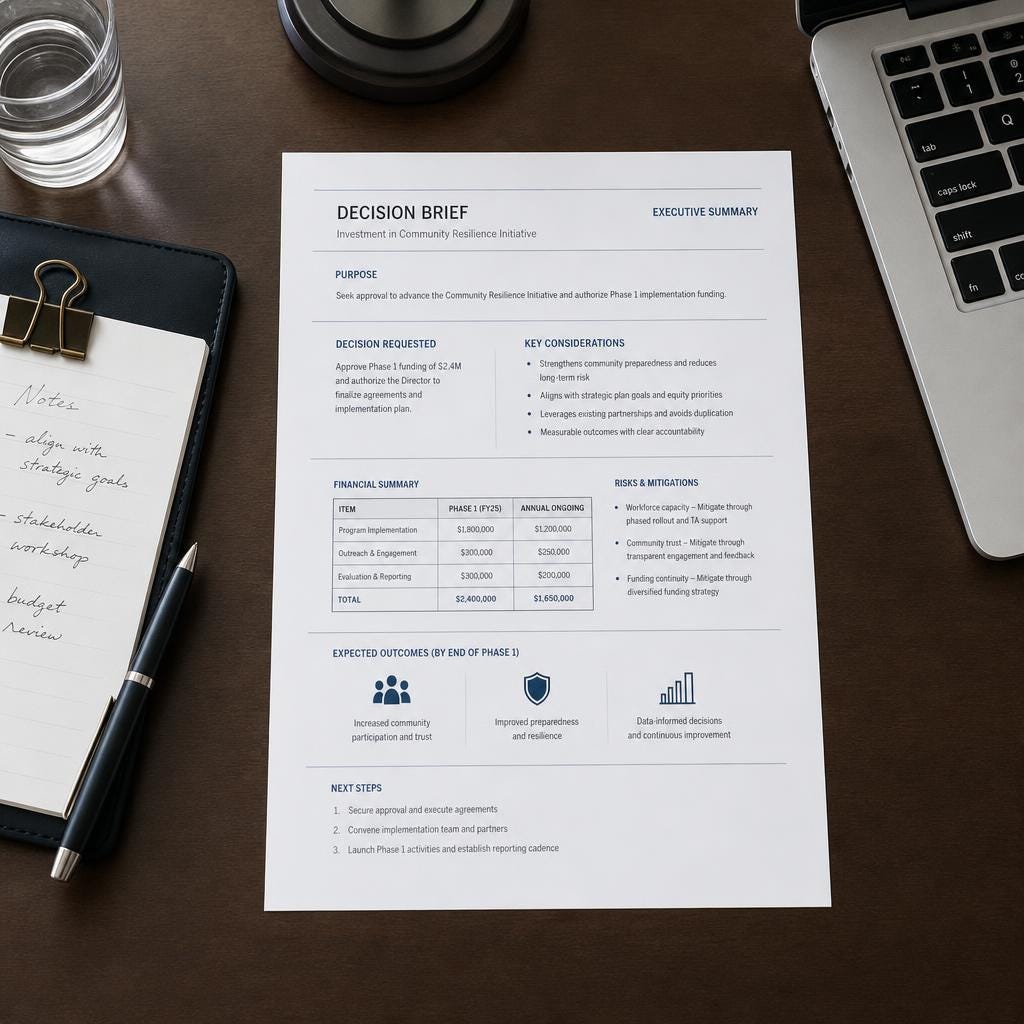
AI has made it easier than ever to produce something that looks like work.
A meeting becomes a transcript. A transcript becomes a summary. A summary becomes a report. A report becomes a dashboard. A dashboard becomes a recommendation list. Every step looks useful. Every artifact has structure. Every output can be defended as progress.
And still, the leader may be no closer to a decision.
That is the part we need to get honest about.
The problem is no longer whether our systems can create more output. They can. The problem is whether that output arrives in a form that reduces the burden on the person who has to exercise judgment.
More output is not automatically more command.
Sometimes it is just more inventory.
Leaders already live inside review burden. They review emails, meeting notes, staff recommendations, project updates, budget questions, policy drafts, calendar conflicts, personnel issues, vendor proposals, family obligations, and their own unfinished commitments. Add AI to that environment, and the system can suddenly produce more structured material than any responsible operator can absorb.
That looks like leverage from a distance. Up close, it can become another layer of work.
Every summary still has to be trusted. Every recommendation still has to be interpreted. Every draft still has to be checked. Every alert still has to be sorted. Every dashboard still asks the leader to decide what matters.
The real test is not whether an artifact is well formatted.
The real test is whether it can ask for a decision.
That is the standard I am starting to care about more. Work is not under command until it can produce a bounded decision.
A bounded decision does not mean the answer is obvious. It means the work has been shaped so the decision-maker can see what is being asked, what evidence exists, what remains uncertain, what is blocked, and what happens next.
Without that shape, the artifact may still be useful, but it is not done.
It is waiting for someone else to finish the thinking.
This is where much AI-supported work quietly fails. The system produces content, but the operator has to reconstruct the context. The system produces options, but the operator has to infer the decision. The system produces analysis, but the operator must remember the risk model, boundaries, approvals, and stop conditions.
That is not command. That is delegated ambiguity.
A better unit of work is what I have been calling a proof packet.
The name matters less than the structure. A proof packet is not just a memo. It is not just a summary. It is not a dashboard pretending to be a decision. It is a compact operating unit that carries enough context for a leader to approve, revise, park, or kill the work without rebuilding the whole situation from memory.
At a minimum, it should answer seven questions.
What decision is being requested?
What evidence is available?
Who owns the next move?
Who has to approve it?
What constraints or sensitive boundaries apply?
What actions are blocked until the decision is made?
What would cause this to stop, park, or change direction?
That structure sounds simple, but it changes the work.
A normal report says, here is what I found.
A better report says, here is what I found and what decision it supports.
A normal recommendation says, here is what we could do.
A better recommendation says, here are the options, here is the evidence, here is what I am asking you to approve, and here is what stays blocked until you do.
A normal AI summary says, here are the key points.
A better AI-supported packet says, here are the key points, the risk flags, the open questions, the owner, and the next decision.
That distinction matters because leaders do not only manage information. They manage consequences.
The more consequences a decision carries, the less acceptable it is to hand someone a pile of organized material and call the work complete. Organization helps, but organization is not the same as judgment. A clean artifact can still force the leader to do too much hidden labor.
This is especially important as AI moves deeper into real workflows. It is one thing for a tool to summarize a document. It is another thing for an operating system to monitor commitments, draft messages, surface risks, recommend actions, and prepare external work. Once systems begin influencing action, they need more than intelligence. They need command discipline.
Command discipline means the system knows where its authority stops.
It knows what requires human approval.
It knows what evidence must be attached.
It knows which details should not be exposed.
It knows when convenience is not enough reason to proceed.
It knows how to fail closed.
That may sound slower. In practice, it is what makes speed safer.
A leader can move faster when the packet honestly carries the burden. Decision requested. Evidence available. Boundaries named. Blocked actions visible. Next move clear. Stop condition defined.
The operator should not have to remember all of that from scattered context.
The work should carry it.
This is also how systems earn trust over time. Not by producing more. Not by sounding confident. Not by generating polished language. Trust grows when the system repeatedly brings work forward in a shape that respects judgment.
A trusted system does not hide uncertainty. It names it.
A trusted system does not bury the approval gate. It makes it visible.
A trusted system does not turn every idea into an active commitment. It gives the leader a way to park or kill the work cleanly.
That last part matters. Command is not only the ability to act. It is also the ability to stop.
A lot of leaders are drowning in work that was never rejected. The idea was interesting, so it stayed. The draft had potential, so it stayed. The project might matter later, so it stayed. The dashboard looked useful, so it stayed. Eventually, the system is full of half-decisions, and every review becomes an archaeological dig through old intent.
A proof packet forces a cleaner choice.
Approve it.
Revise it.
Park it.
Kill it.
Those are not just workflow labels. They are acts of command.
Approve means the work has sufficient evidence and alignment to move forward.
Revise means the direction is promising but not decision-ready yet.
Park means the idea may have value, but not now.
Kill means the system should stop carrying it.
That kind of clarity protects capacity. It prevents every useful idea from becoming permanent inventory. It gives the operator a way to keep ambition without letting ambition become clutter.
This is the next standard I want from AI-supported work, personal operating systems, and leadership workflows.
Do not just capture more.
Do not just summarize better.
Do not just produce cleaner dashboards.
Bring the work forward in a form that can be decided.
Because until the work can ask for a decision, it is not really finished.
It is just waiting for the operator to finish it.