

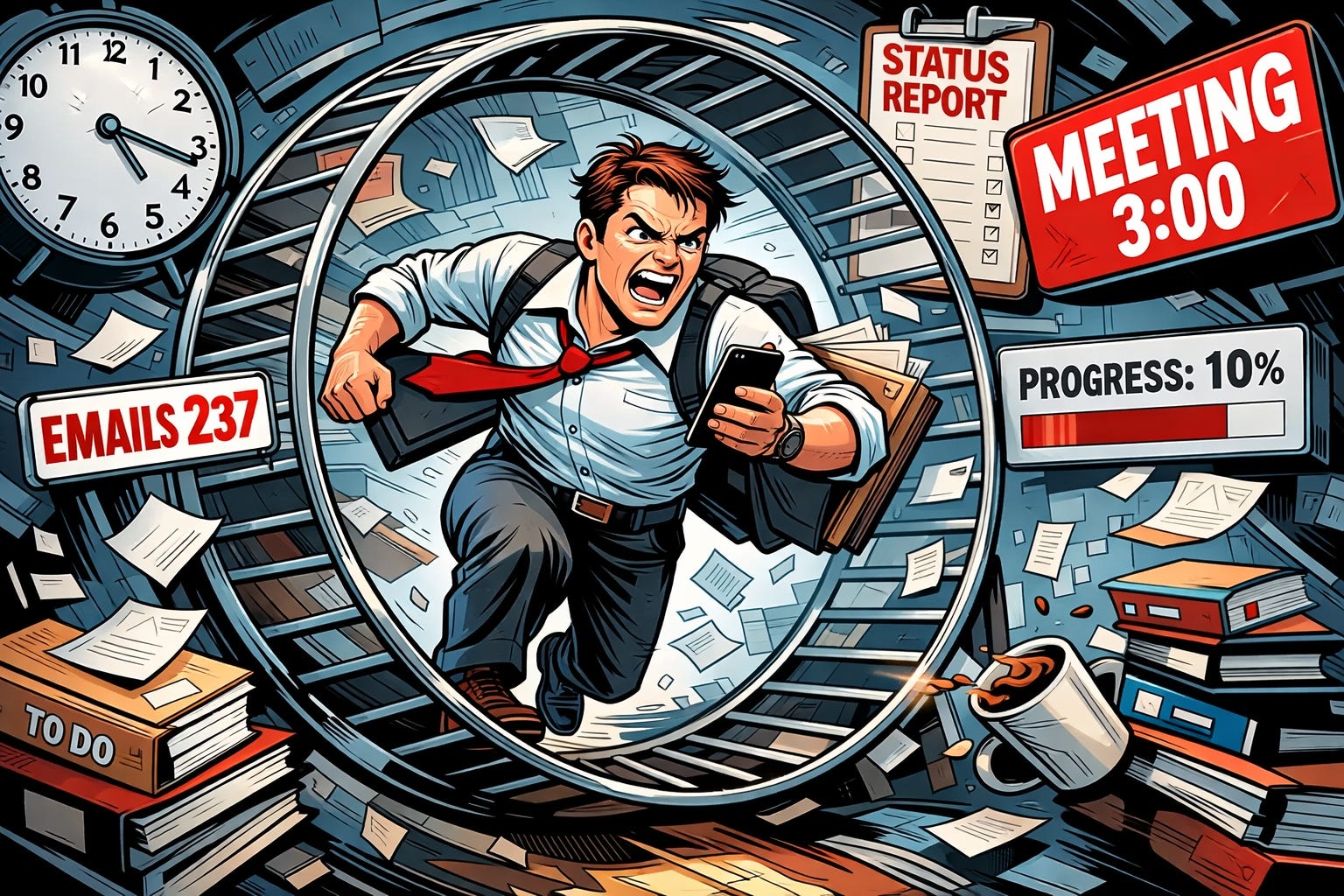
You shipped twelve things last week.
Email responses. Meeting notes. Status updates. Slack threads. Calendar invites. Project reviews. Budget approvals. Team check-ins. Document edits. Committee work. Coordination calls. Quick syncs.
Twelve discrete outputs. Measurable activity. Visible motion.
Now tell me: what actually moved forward?
Not what kept moving. Not what stayed operational. Not what got maintained.
What progressed? What advanced? What got closer to done?
If you’re being honest, the answer is probably one thing. Maybe two. On a good week.
The other ten things? They were motion. Important motion, maybe. Necessary motion, often. But motion nonetheless.
And the problem isn’t that motion exists. It’s that motion feels like progress. It looks like progress. It masquerades as progress so convincingly that most executives can’t tell the difference anymore.
Until they hit the execution gap.
The Difference That Matters
Progress means the project advanced. The decision moved from pending to made. The deliverable went from 60% to 80% complete. The strategy shifted from draft to actionable. The system went from broken to fixed.
Motion means you did work related to the project. You attended the meeting about the decision. You reviewed the deliverable. You commented on the strategy. You discussed the broken system.
Motion is real work. It requires time, energy, and cognitive load. It produces outputs: emails sent, meetings held, and comments made. It feels productive because you were busy. You were doing things.
But busy isn’t the same as effective.
The meeting where you discussed the decision? That was motion. Making the decision? That’s progress.
Reviewing the deliverable and adding comments? Motion. Actually writing the missing sections? Progress.
Talking about the broken system in three different meetings? Motion. Fixing it? Progress.
Motion maintains. Progress compounds.
Why Motion Wins
Here’s the uncomfortable truth: organizations reward motion more than progress.
Attendance signals commitment. Responsiveness signals reliability. Participation signals engagement. Being “in the loop” signals importance.
Progress? That’s hard to measure in the moment. It’s lumpy. It’s uneven. It doesn’t happen on a predictable schedule. You can’t put it on a status report as easily as “attended 12 meetings this week.”
So motion becomes currency. Show up. Respond quickly. Stay visible. Keep things moving.
The system interprets this as productivity. Your calendar proves you were busy. Your email count proves you were responsive. Your meeting attendance proves you were engaged.
Meanwhile, the projects that require deep focus, sustained attention, and uninterrupted time? Those slip. Not because you’re lazy. Not because you don’t care. Because the infrastructure rewards motion over progress.
You get recognized for being in every meeting. You don’t get recognized for blocking three hours to actually finish something.
The incentive structure is perfectly calibrated to maximize motion while minimizing progress.
The Coordination Tax
Motion isn’t just inefficient. It’s expensive.
Every meeting costs preparation time before and follow-up time after. Every email thread requires context switching to parse and respond. Every status update requires reconstruction of where things stand.
This is the coordination tax. The overhead required to keep everyone informed, aligned, and synchronized.
And here’s what makes it insidious: each individual instance feels necessary. That meeting probably needed to happen. That email probably needed to be sent. That status update probably needed to exist.
The problem isn’t any single instance. It’s the collective load.
You spend Monday preparing for Tuesday’s meeting. Tuesday in the meeting. Wednesday, following up on the meeting. Thursday, preparing for Friday’s related meeting. Friday in that meeting.
The week is over. You were busy every single day. Your calendar is full. Your email count is high. You feel exhausted.
But the actual work that needed doing, the writing, the analysis, the decision-making, the creation, got squeezed into the margins. Early morning before the meetings started. Late evening after they ended. Maybe over the weekend, if you get desperate.
The coordination tax consumed the execution time. Motion crowded out progress.
The Visibility Paradox
Motion is visible. Progress often isn’t.
When you’re in meetings all day, people see you. When you’re responding to emails and Slack messages, people know you’re working. When you’re coordinating across teams, updating stakeholders, and attending standups, everyone can confirm you’re engaged.
When you’re writing the strategy document that’s been on your list for six weeks? You’re invisible. No one sees that work happening. It doesn’t show up on anyone else’s calendar. It doesn’t generate responses. It doesn’t signal activity.
So you start to feel pressure to maintain visibility. To prove you’re working. To demonstrate productivity through motion.
The deep work that actually creates value? That makes you look unavailable. Unresponsive. Maybe not pulling your weight.
This is the visibility paradox. The work that matters most is the work that shows the least. And the work that shows the most often matters the least.
So you optimize for visibility. You maintain motion. You stay in the loop.
And the execution gap widens.
The Progress Illusion
Here’s what makes motion so dangerous: it feels like progress.
You ended the day exhausted. You worked hard. You handled a lot. Your inbox is closer to zero than it was this morning. Your calendar was full. You were productive.
Except productive at what?
Productive at maintaining. At coordinating. At staying synchronized. At keeping the machinery running.
Not productive at advancing. At completing. At finishing. At shipping.
Motion creates the progress illusion. You worked all day, so something must have moved forward. You feel tired, so you must have accomplished something. You were busy, so you must have been effective.
But when you look at your actual project list, nothing fundamental has changed. The same things are pending that were pending last week. The same decisions are unmade. The same deliverables are incomplete.
You ran fast. You just didn’t go anywhere.
What Actually Moved
Pull up your project list from three months ago.
Not your task list. Your actual projects. The strategic work that would move the needle if completed.
How many are done? How many moved from conception to execution to completion?
Now count the meetings you attended. The emails you sent. The coordination calls you joined.
The ratio between those two numbers reveals your motion-to-progress ratio. For most executives, it’s ugly. Hundreds of hours of motion. A handful of items showing real progress.
This isn’t a personal failing. It’s a systems problem.
Your infrastructure is designed to maximize motion. Meetings default to hour-long blocks because that’s what calendars suggest. Coordination is synchronous because that’s what everyone expects.
None of this is actively chosen. It’s just how the system works. And the system produces motion.
So motion wins. Every single day.
The Moment of Clarity
I realized I had a motion problem when I started tracking outcomes against objectives, not just activity against calendars.
ATLAS forced me to answer a different question each week: Did my work move my goals forward, or did it just keep the machinery running?
The data was humbling.
Weeks where I felt incredibly productive (calendar full, inbox managed, stakeholders updated) showed minimal movement on actual strategic objectives. Maybe one advanced. Often zero.
Weeks where I felt like I wasn’t doing enough because my calendar was light? Two or three objectives moved substantially. Projects shipped. Goals progressed.
The correlation was inverse. More calendar time meant less strategic progress. More meetings meant less goal advancement. More coordination meant less outcome delivery.
I wasn’t failing because I wasn’t working hard enough. I was failing because I was working on the wrong things. I had optimized for motion and starved progress.
Your calendar already told you this. You just didn’t have permission to see it.
## The Infrastructure Question
Once you see the difference between motion and progress, you can’t unsee it.
That meeting invite lands. You used to accept automatically. Now you ask: what progress does this create?
That status update request arrives. You used to respond immediately. Now you ask: Is this the most efficient form of motion?
The execution gap isn’t a mystery. It’s visible in your calendar. It’s the difference between your motion budget and your progress budget.
And for most executives, progress is losing.
You can’t willpower your way out of this. You can’t just “be more disciplined” about declining meetings. You can’t just “focus harder” during the motion-heavy weeks.
Those are all individual solutions to a structural problem.
The structure of your work is designed to maximize motion. Your calendar defaults to availability. Your communication tools default to synchronous. Your stakeholders expect responsiveness.
The system works exactly as designed. It produces motion.
If you want progress, you need a different infrastructure.