

Three weeks ago, you recognized you’d hit the capacity cliff. Working harder stopped working.
Two weeks ago, you looked at your calendar and saw the math. The execution time you thought you had never existed.
Last week, you saw the motion trap. Busy isn’t the same as effective. Activity isn’t the same as progress.
Three separate observations. One underlying problem.
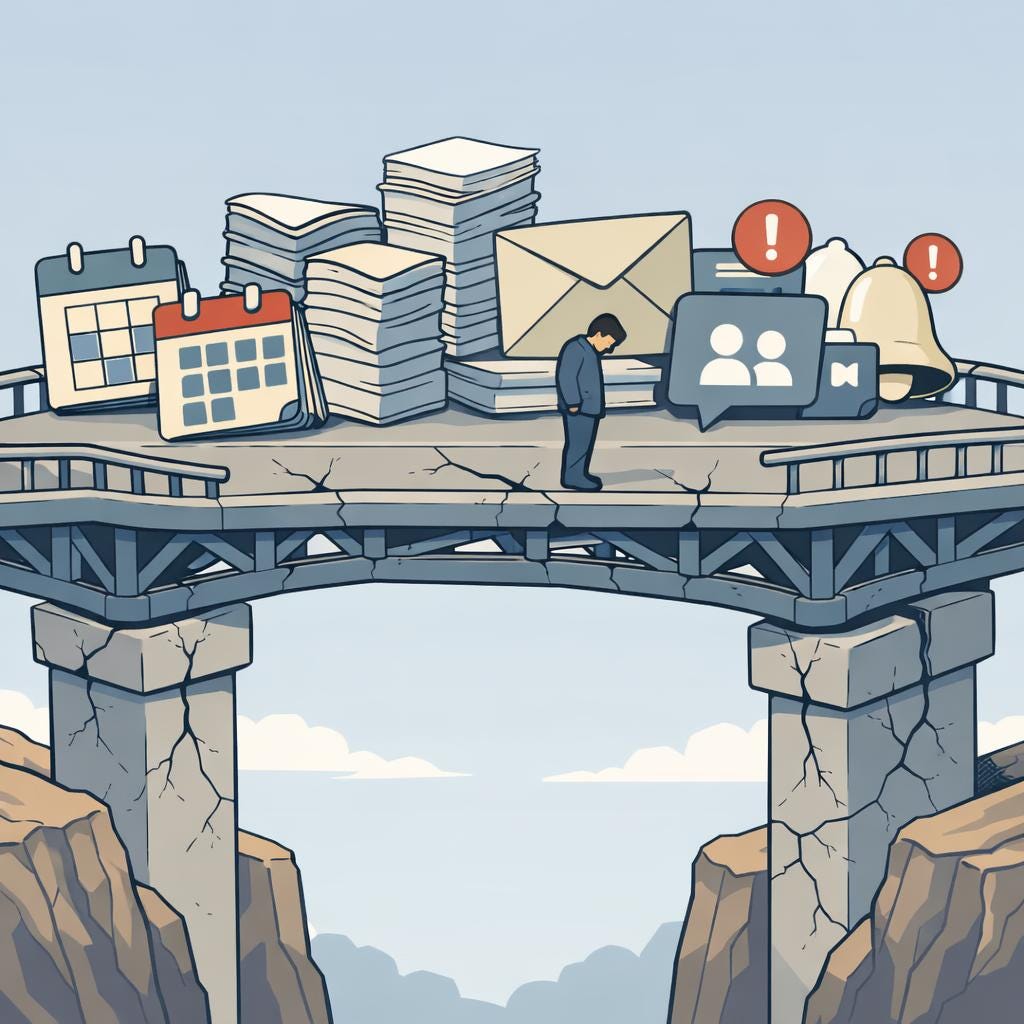
You’re running advanced operations on primitive infrastructure.
This isn’t about productivity hacks or time management techniques. This isn’t about discipline or focus or willpower. This is about architecture. You’ve been trying to execute complex, multi-domain, high-stakes work using infrastructure that was never designed to handle it.
And infrastructure failure doesn’t stay static. It compounds.
The Compounding Effect
Here’s what makes infrastructure failure particularly dangerous: it gets worse over time.
You hit the capacity cliff. Your response? Work longer hours. Sacrifice sleep, exercise, and personal time. Trade your health for temporary capacity. It works for a while. Until your body stops cooperating and you can’t participate in your own life.
You see, the calendar math doesn’t work. Your response? Get better at multitasking. Context-switch faster. Compress meeting prep. Handle emails during calls. It creates the illusion of efficiency. Until the cognitive load catches up and the quality of everything degrades.
You recognize the motion trap. Your response? Try to be more disciplined about saying no. Block focus time. Protect deep work hours. It helps for a week or two. Until the organizational pressure reasserts itself and your calendar fills back up with coordination work.
Each individual fix makes sense. Each one fails because it’s addressing a symptom, not the structure.
Meanwhile, the underlying problem accelerates.
Your task list grows faster than you can clear it. Your coordination overhead increases with each new stakeholder. Your context-switching costs compound as you add more domains. Your recovery time lengthens with each week of operating at 100% capacity.
The infrastructure deficit isn’t stable. It’s growing. And every tactical fix you apply just delays the reckoning.
What Deficit Actually Means
An infrastructure deficit means your operational demands exceed your system’s designed capacity.
If you’re managing three major domains, but your task system was built for sequential work, you have an infrastructure deficit.
If you need 25 hours of execution time per week, but your calendar provides 12 hours after accounting for meetings and switching costs, you have an infrastructure deficit.
If your work requires deep focus and sustained attention, but your environment defaults to interruption and responsiveness, you have an infrastructure deficit.
The deficit is the gap between what your work actually requires and what your infrastructure can actually support.
And here’s the crucial part: you can’t close that gap with effort. You can’t willpower your way to more capacity. You can’t discipline yourself into infrastructure that doesn’t exist.
You can only do three things with an infrastructure deficit:
1. Reduce your operational demands (do less)
2. Accept lower quality output (care less)
3. Rebuild your infrastructure (work differently)
Most executives choose option 4: ignore the deficit and hope it resolves itself. It never does.
The Real Cost
The immediate cost of infrastructure failure is visible. Missed deadlines. Incomplete projects. Stakeholder frustration. The constant feeling of being underwater.
But those aren’t the costs that matter most.
The real cost is strategic incapacity.
Every hour you spend managing calendar pollution is an hour you’re not thinking strategically. Every day dominated by reactive motion is a day you’re not advancing proactive progress. Every week operating at the margin of your capacity is a week you can’t take on anything new.
The infrastructure deficit doesn’t just prevent you from getting your current work done. It prevents you from doing the work that would actually matter.
You can’t take on that high-impact project because you’re already at 100% utilization. You can’t explore that strategic opportunity because you have no bandwidth. You can’t invest in that relationship, skill, or initiative because your system is fully subscribed just maintaining current operations.
The deficit locks you into maintenance mode. And maintenance mode is how careers plateau.
You became successful by taking on new challenges. By expanding your scope. By doing work that mattered. But infrastructure failure prevents all of that. You’re trapped running the existing system while opportunities pass you by.
That’s the actual cost. Not burnout. Not stress. Strategic incapacity.
You’re so busy managing the deficit that you can’t build the future.
Why It Stays Broken
You know the system is broken. You’ve known for months, maybe years. So why haven’t you fixed it?
Because fixing infrastructure feels impossible while you’re still operating on it.
Imagine trying to rebuild a bridge while traffic is still crossing it. That’s what infrastructure replacement feels like when you’re at 100% capacity. You don’t have spare bandwidth to redesign your systems. You’re using every available hour just to keep current operations from collapsing.
So you make incremental adjustments. You optimize at the margins. You try new productivity apps. You rearrange your calendar. You batch your email. Each change helps a little. None of them fix the fundamental problem.
Meanwhile, the organizational structure that created the deficit is still in place. The meeting culture that fills your calendar. The communication norms that expect real-time responsiveness. The stakeholder expectations that treat your time as infinitely available.
You can’t fix your personal infrastructure while the organizational infrastructure keeps recreating the same pressures.
This is why individual productivity advice fails. It assumes you have agency over your own infrastructure. Most executives don’t. They’re operating within systems that actively resist the changes needed to close the deficit.
And even if you had complete autonomy, you’d still face the bootstrapping problem: you need capacity to rebuild infrastructure, but you can’t create capacity without better infrastructure.
The system is perfectly designed to stay broken.
The Pattern You Can’t Unsee
Once you see the infrastructure deficit, you can’t unsee it.
That new project request comes in. You used to evaluate it based on interest or importance. Now you immediately think: Do I have the infrastructure to support this?
That meeting invite arrives. You used to accept or decline based on relevance. Now you calculate: what’s the switching cost, and can my calendar absorb it?
That productivity article promises a better system. You used to try it immediately. Now you ask: Is this addressing infrastructure or just optimizing within broken constraints?
The deficit becomes the lens through which you see everything. And what you see is that most advice, most tools, most systems are designed for a world that doesn’t match your reality.
They assume you have control over your calendar. You don’t.
They assume you work in one domain at a time. You don’t.
They assume you can block focus time and people will respect it. They won’t.
They assume infrastructure that doesn’t exist. And then blame you when their system doesn’t work in your context.
This isn’t a personal failure. You haven’t failed to implement their system correctly. Their system was never designed for your infrastructure constraints.
The Shift That Changes Everything
Here’s what has to change: you have to stop trying to execute better on broken infrastructure and start building infrastructure that actually fits your work.
Not someone else’s infrastructure. Not the system that worked for the productivity guru who doesn’t manage three departments and four stakeholder groups. Not the framework designed for someone working in a different industry, with different constraints, under different pressures.
Your infrastructure. Built for your actual work, your actual complexity, your actual life.
This is the shift that matters. From optimization to architecture. From tactics to systems. From working harder on broken infrastructure to building infrastructure that makes the work possible.
The capacity cliff, the calendar deficit, the motion trap—they’re all symptoms of the same root cause. You’re running operations that require advanced infrastructure on systems designed for simple, sequential work.
You can’t fix that with discipline. You can’t solve it with willpower. You can’t overcome it with effort.
You can only fix it by building different infrastructure.
What Comes Next
The infrastructure deficit is real. The costs are compounding. The current path is unsustainable.
But recognizing the problem doesn’t solve it. And that’s where most productivity advice stops. “Here’s what’s broken. Good luck fixing it.”
That’s not good enough.
If off-the-shelf productivity systems don’t work (and they don’t), what does? If adopting someone else’s framework creates more problems than it solves (and it does), where do you start?
If the infrastructure you have can’t support the work you need to do, how do you build infrastructure that can?
Those are the questions that matter. And those are the questions we’re going to answer.
Not with another productivity system to adopt. Not with another framework to force your work into. Not with another set of rigid rules designed for someone else’s life.
With principles. With architecture. With understanding how to build your own operating system from the ground up.
The deficit is the problem. Architecture is the answer.
Let’s build it.