

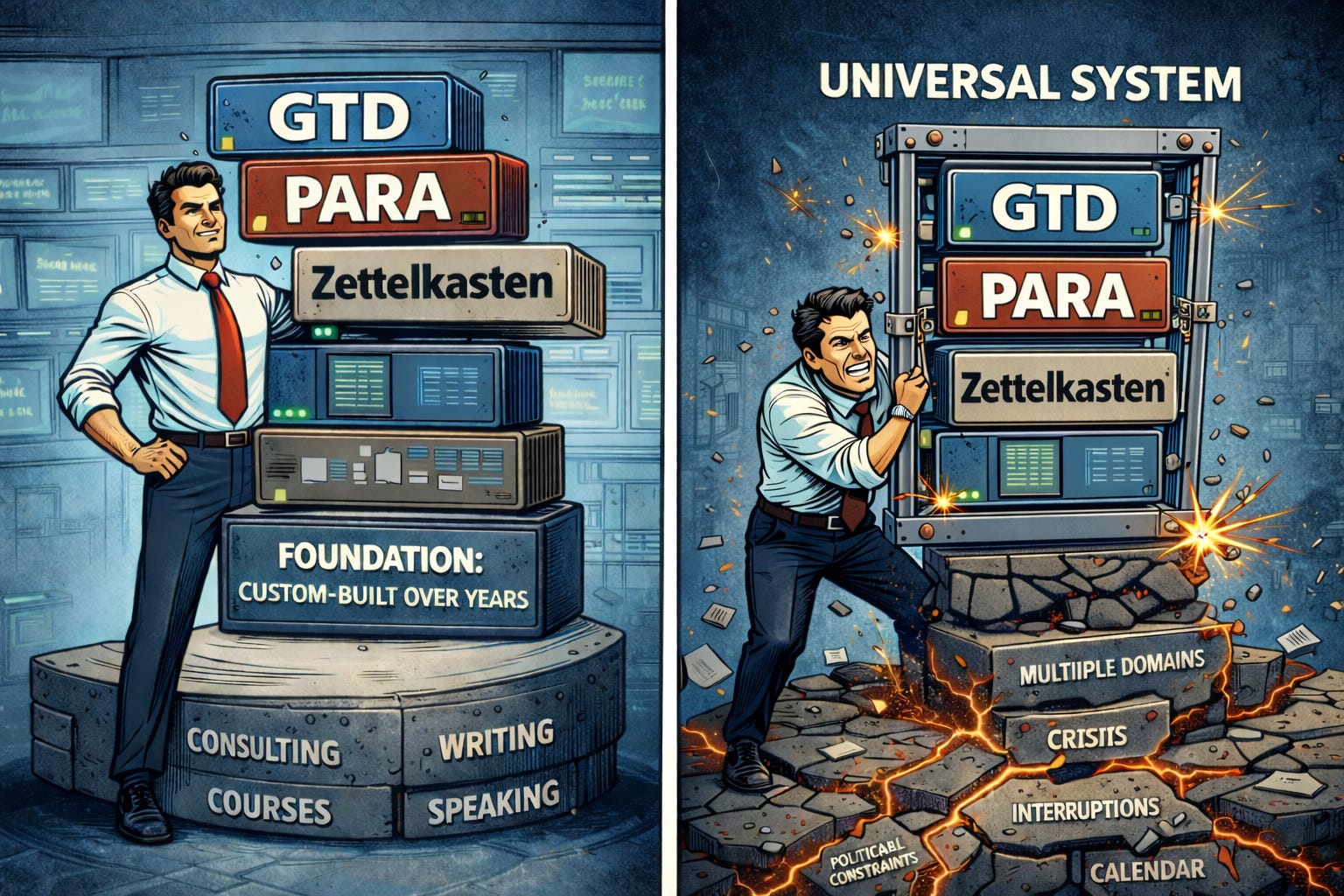
David Allen’s system works for David Allen.
Of course it does.
He spent years building it. Refining it. Adjusting it to fit his brain, his work, his constraints. Every edge case that broke it, he fixed. Every workflow that didn’t fit, he adapted. By the time GTD became a book, it wasn’t a system he’d invented. It was a system he’d evolved through thousands of hours of real-world use, failure, and iteration.
What he sold us wasn’t that system.
What he sold us was a snapshot. A description of where his system was at one moment in time, translated into language general enough to apply to anyone. Stripped of the context that made it work. Stripped of the years of adaptation that shaped it. Stripped of the specific constraints of his work that the architecture was quietly built around.
We bought the snapshot. He kept the system.
And then you wondered why it didn’t work the same way for you.
What They Don’t Tell Us About Their System
Every productivity author has the same origin story. They were overwhelmed. Struggling. Couldn’t keep up. Then they built something that worked. And now they’re teaching it to us.
What they skip is the middle part.
The years between “I built something” and “I’m teaching it.” The iterations. The failures. The times the system broke, and they rebuilt it. The gradual, invisible process of a system learning its owner, and an owner learning their system.
By the time they write the book, the system fits them like shoes they’ve worn for years. They forgot what it felt like to fight it.
Tiago Forte didn’t adopt PARA in an afternoon. He built it over years of thinking about how information moves through his work. The four categories, Projects, Areas, Resources, Archives, aren’t arbitrary. They reflect how his brain organizes meaning. They map to his work rhythms, his domain structure, his definition of what’s active versus reference.
When those categories don’t match your work, it’s not because you’re implementing it wrong. It’s because the taxonomy was never built for your terrain.
The Complexity They Were Solving
Here’s what most productivity systems have in common: they were built by people whose primary work is knowledge creation.
Writing. Teaching. Thinking. Speaking. Creating content.
That’s not a criticism. It’s just context.
GTD was built by a consultant and executive coach. PARA by a productivity teacher and online course creator. Zettelkasten by an academic sociologist. Their systems are optimized for their actual work, which involves a lot of reading, thinking, writing, and managing their own projects.
What they weren’t optimizing for: managing three departments simultaneously. Making operational decisions under time pressure while also driving strategic initiatives. Switching between crisis response and long-term planning within the same hour. Coordinating across multiple stakeholder groups with competing priorities.
Your work isn’t their work.
Their systems handle their complexity. Yours is different in kind, not just degree. And when architecture assumes the wrong terrain, it doesn’t strain. It fails.
GTD’s context lists assume you can choose what to work on based on your current location or energy. You often can’t. Your next action is determined by which crisis just escalated, not which context you’re in.
PARA’s project structure assumes bounded, well-defined initiatives with clear completion criteria. Your work often isn’t. Strategic initiatives don’t have finish lines. Operational domains don’t close.
Zettelkasten assumes you have time for deep, unhurried thinking. Time to let ideas connect slowly across notes. That kind of thinking matters. It’s where real insight comes from, and any system worth building needs to protect it.
But Zettelkasten can’t flex. It assumes the deep work happens on your schedule. In your dedicated block. Undisturbed. What it can’t do is adapt when that block disappears. When the morning you reserved gets consumed by a crisis and the only available thinking time is a forty-minute window at 3pm between calls.
A system built for your reality doesn’t just preserve deep work. It moves with you when reality shifts. The work still gets done. Just not always when you planned.
None of this is a case against these systems.
GTD is a genuine contribution.
PARA clarified how information moves through work.
Zettelkasten changed how serious thinkers build knowledge.
These aren’t bad systems. They’re just not yours.
The problem was never the prescription. It was the assumption that a prescription could transfer without the context that made it work.
The systems weren’t wrong. They were solving a different problem than yours.
The Evolution They Don’t Show Us
There’s something else missing from the productivity book origin story: the system you’re reading about isn’t the system they use today.
GTD was published in 2001. The book is a historical document. The practice is a living system.
Same with every framework we’ve tried. The creator’s current system has diverged significantly from what they published. Real systems evolve. They respond to new tools, new constraints, new kinds of work. When they stop working, they get rebuilt.
What we implemented was the version they published. What they use is the version that survived contact with reality.
But here’s the part that never makes it into the book at all: alongside the system, they built habits.
Not just the methodology — the daily behaviors that run it. The weekly review that happens automatically because it’s been ingrained for fifteen years. The capture reflex that fires before conscious thought. The classification instinct that doesn’t require deliberation anymore because they’ve made that decision ten thousand times.
The system and the habits are inseparable. You can’t see where one ends and the other begins, which is exactly why it looks so effortless when they describe it.
What we adopted was the system. What they have is the system plus the habits that make it run without friction. We inherited the blueprint. They kept the muscle memory.
That’s not a small gap. Habits are the engine. Without them, even a well-designed system requires constant conscious effort to maintain. And conscious effort is a limited resource. It depletes. It gets crowded out by urgency. It collapses the moment your week gets complicated.
Which is exactly when you need your system most.
You can’t transfer habits from a book. They have to be built: through repetition, through failure, through the slow process of a behavior becoming automatic. The creator had years to build theirs inside a system designed for their context.
You were trying to build yours inside someone else’s system, under full operational load, from day one, while still expected to perform.
Of course it broke.
What This Actually Means for You
We didn’t fail to implement GTD correctly. We implemented the published version, which was never designed for our complexity, and discovered what every serious practitioner eventually discovers: the published system is a starting point, not a destination.
The creators know this. They just don’t lead with it. Because “here’s a starting point you’ll spend years adapting” doesn’t sell books the way “here’s the system that will finally solve your productivity problem” does.
But it’s the truth.
No system we adopt will work as described. Every system requires adaptation. The question isn’t whether you’ll need to modify it. You will. The question is whether the underlying architecture is flexible enough to handle your modifications, or whether bending it to fit your context breaks what made it work in the first place.
Most prescriptive systems break under modification. The architecture assumes a specific context. Change the context, and the structure collapses.
That’s not a bug in your implementation. That’s a feature of prescription.
Prescription works when context matches. When your work resembles the creator’s work closely enough that their architecture fits yours. For some people, GTD fits well enough. For most executives managing real complexity across multiple domains, it doesn’t.
And the gap between “fits well enough” and “fits your actual work” is exactly where the adaptation tax gets paid. Every hour spent translating your work into their categories. Every workaround built to handle the cases their system didn’t anticipate. Every habit you tried to build around behaviors that didn’t fit how you actually work — and the frustration when those habits never stuck because the system kept fighting you.
You weren’t failing the system. You were paying the price of mismatched architecture.
The Shift
Stop asking: How do I implement this system correctly?
Start asking: What architecture do I actually need?
Those are different questions. The first assumes the system is right and you need to execute it better. The second assumes your context is the constraint and you need architecture that fits it.
The creator’s advantage isn’t their specific system. It’s that their system was built for them. Evolved for them. Shaped around their actual constraints over years of real use. And the habits that run it were built inside architecture that fit, so each repetition reinforced something that worked, rather than something that fought.
You can have that too.
Not by adopting their system and hoping the habits follow. But by building architecture that actually fits your terrain — and then building habits inside that architecture. Habits that compound because they’re working with your system, not against it.
That’s what comes next. Not another system to try. Not another set of habits to force onto broken infrastructure. Architecture that fits. And habits worth building. That’s the difference between adoption and design.