

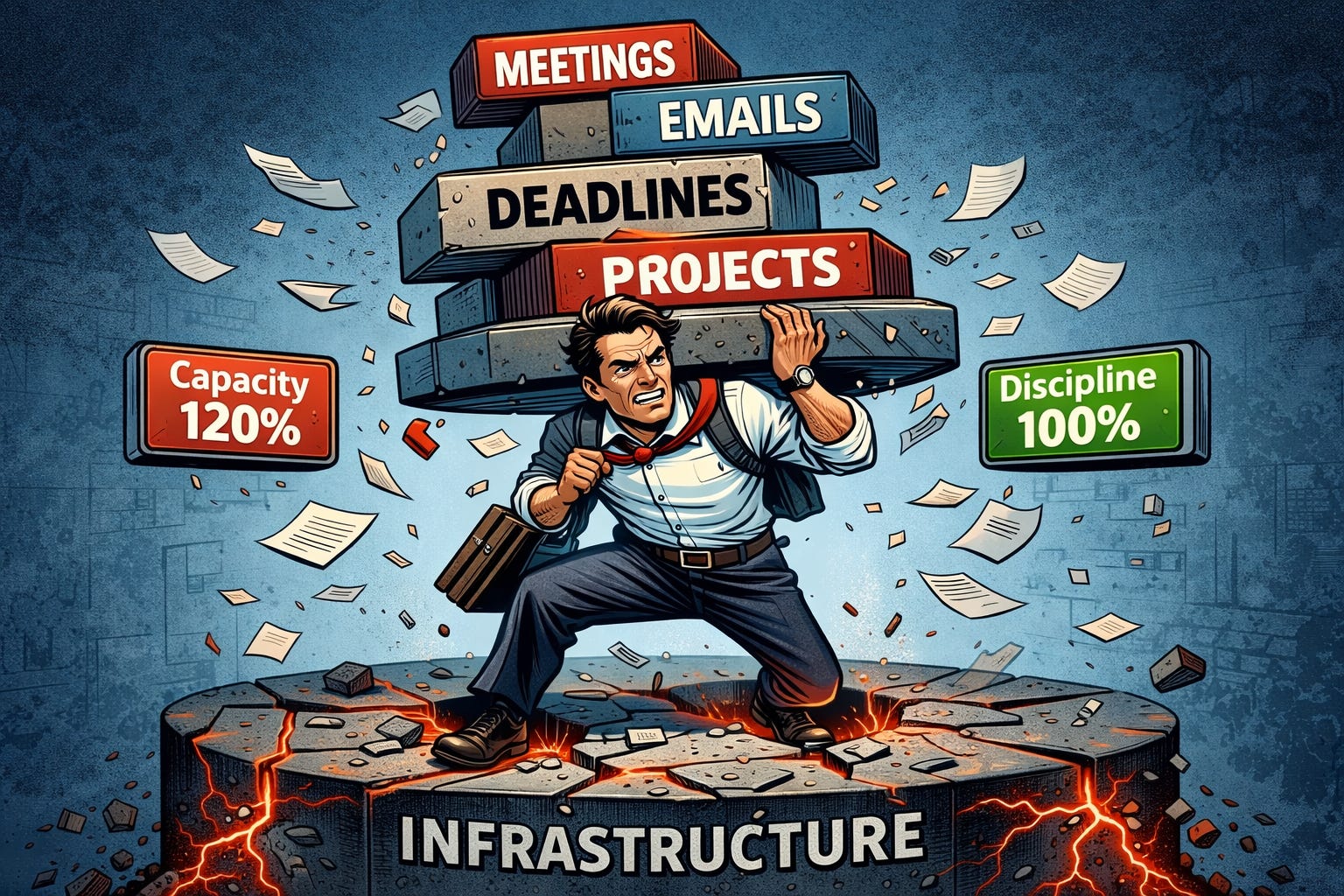
You’ve been getting the wrong advice.
Work smarter, not harder. Prioritize ruthlessly. Say no more often. Wake up earlier. Batch your tasks. Time block your calendar. Use the Pomodoro technique. Eliminate distractions. Build better habits. Be more disciplined.
All of it assumes the same thing: the problem is you.
Your execution. Your focus. Your consistency. Your willpower. If you just tried harder, planned better, or stayed more disciplined, the execution gap would close.
It won’t.
Because the problem isn’t discipline. It’s infrastructure.
And no amount of personal optimization fixes structural failure.
The Discipline Trap
Discipline is seductive. It puts you in control. If the problem is discipline, then the solution is effort. Work harder. Focus better. Be more consistent.
That feels empowering. You’re not helpless. You’re not stuck. You just need to execute better.
So you try. You wake up at 5am. You block your calendar. You turn off Slack. You follow the system religiously. And it works. For a week. Maybe two.
Then reality reasserts itself. The urgent email that can’t wait. The crisis that requires your immediate attention. The stakeholder who needs you now. The meeting you can’t decline without political cost.
Your discipline held. The infrastructure didn’t.
And every time the system breaks despite your best efforts, you assume you weren’t disciplined enough. That you need to try harder next time. Be more committed. More focused. More consistent.
The failure reinforces the diagnosis: you’re the problem.
But you’re not.
You’ve been trying to discipline your way around infrastructure that fundamentally cannot support the work you need to do. That’s not a discipline failure. That’s an architecture failure.
Discipline cannot create execution time that doesn’t exist. Willpower cannot make your calendar math work. Consistency cannot turn motion into progress when the system is designed to produce motion.
You can be perfectly disciplined while running on perfectly broken infrastructure. The discipline just makes the failure hurt more.
What Infrastructure Actually Means
Infrastructure is the system that enables work to happen.
Your calendar is infrastructure. It determines when work can occur, how much context switching you’ll endure, and whether execution time actually exists.
Your task system is infrastructure. It determines whether work is captured, classified, prioritized, and made executable—or just accumulated into an anxiety-inducing list.
Your information system is infrastructure. It determines whether you can find what you need when you need it, or spend hours searching for something you know you captured six weeks ago.
Your communication system is infrastructure. It determines whether coordination happens efficiently or consumes all your execution capacity.
When infrastructure is adequate, discipline amplifies effectiveness. When infrastructure is inadequate, discipline amplifies exhaustion.
Right now, your infrastructure is inadequate.
That’s not a personal judgment. It’s a structural observation. You’ve hit the capacity cliff. Your calendar math doesn’t work. You’re trapped in motion. The infrastructure deficit compounds weekly.
Those aren’t discipline problems. Those are infrastructure problems that discipline cannot solve.
Why Discipline Fails
Discipline operates at the individual level. It helps you execute better within your constraints.
But what happens when the constraints themselves are broken?
You can decline meetings. Protect focus blocks. Prioritize ruthlessly. None of it creates infrastructure that doesn’t exist.
Discipline works within the system. But when the system itself is the problem, discipline just optimizes failure.
You’re being perfectly disciplined. You’re following the advice. You’re trying harder.
And you’re still underwater. Still reactive. Still watching strategic work slip while operational demands consume everything.
That’s not because you lack discipline. It’s because you’re running operations that require advanced infrastructure on systems designed for simple, sequential work.
No amount of discipline bridges that gap.
The Cost of Misdiagnosis
Here’s what makes the discipline trap so dangerous: it’s infinitely flexible.
Every time the system fails, you can find a discipline explanation. You could have woken up earlier. Said no more firmly. Focused harder. Been more consistent.
The advice is always the same: try harder. Be better. Execute more effectively.
And because you’re a high performer, you do. You sacrifice sleep. You skip workouts. You work weekends. You trade your health for temporary capacity.
It works. For a while.
Until your body stops cooperating. Until you’re sitting on a cruise ship watching your kids fly while you physically cannot participate in your own life because you spent years sacrificing wellness for a capacity that was never enough anyway.
Discipline didn’t fail. Your infrastructure demanded a cost you couldn’t sustain.
But the misdiagnosis persists. Try harder. Be more disciplined. Optimize better.
The advice keeps you focused on personal optimization while the structural problem compounds. The infrastructure deficit grows. The calendar pollution worsens. The motion-to-progress ratio tilts further toward motion.
Meanwhile, you’re burning out trying to discipline your way around infrastructure that was never designed to support this work.
The real cost isn’t exhaustion. It’s opportunity cost. Strategic incapacity. Every hour spent trying harder at broken infrastructure is an hour not spent rebuilding better infrastructure.
You’re trapped optimizing the wrong thing.
What Actually Changes
If discipline isn’t the answer, what is?
Architecture.
You don’t need to try harder. You need to work differently. On different infrastructure. Built for your actual complexity.
That doesn’t mean abandoning discipline. Discipline still matters. But discipline without architecture is just effort without leverage.
You need infrastructure that accounts for your real capacity. Not theoretical capacity. Infrastructure that handles multiple domains without collapsing. Infrastructure that creates execution time instead of assuming it exists. And infrastructure that doesn’t break the moment complexity increases.
That infrastructure doesn’t exist on someone’s shelf. You can’t buy it. You can’t adopt it. You can’t force your work into someone else’s framework and expect it to handle your reality.
You have to build it. From principles, not prescriptions. For your context, not someone else’s.
But here’s the problem: you’ve probably already tried that.
You’ve tried GTD. PARA. Zettelkasten. Time blocking. Bullet journaling. The 12 Week Year. Every productivity system that promised to solve the execution gap.
They all worked. For a while. Then they broke. Again.
And every time one failed, you wondered if maybe you just weren’t implementing it correctly. If you needed to be more disciplined about following the system. If you were the problem.
You weren’t.
Those systems weren’t designed for your infrastructure needs. They were designed for someone else’s work, someone else’s context, someone else’s constraints.
You weren’t failing the system. The system was never designed for your work.
And that’s what we need to talk about next.
The Shift
Stop asking “How can I execute better on this infrastructure?”
Start asking “What infrastructure do I need to make this work executable?”
That’s not a subtle shift. It’s fundamental.
One question leads to productivity advice. Work harder. Focus better. Be more disciplined. Optimize within constraints.
The other question leads to architecture. What enables execution? What creates capacity? What turns motion into progress? What infrastructure actually fits this work?
The first question assumes you’re broken. The second recognizes the system is.
For the past four weeks, we’ve been diagnosing the execution gap. The capacity cliff you hit when working harder stops working. The calendar math that proves you never had the time you thought you had. The motion trap that keeps you busy without making you effective. The infrastructure deficit that compounds every week you operate at maximum capacity.
All of that diagnosis pointed to one conclusion: this isn’t a personal failure. It’s an infrastructure failure.
Now we need to talk about why the infrastructure you’ve tried to adopt hasn’t worked. And what you need to build instead.
Because the answer isn’t discipline. It’s architecture.
And architecture starts with understanding why off-the-shelf systems fail—so you can build infrastructure that actually fits.
Next week: the system graveyard. Every productivity framework you’ve tried and abandoned. Why they worked for their creators but broke for you. And what that reveals about the difference between adopting systems and building architecture.
You don’t need more discipline. You need better infrastructure.
Stop trying harder. Start building differently.